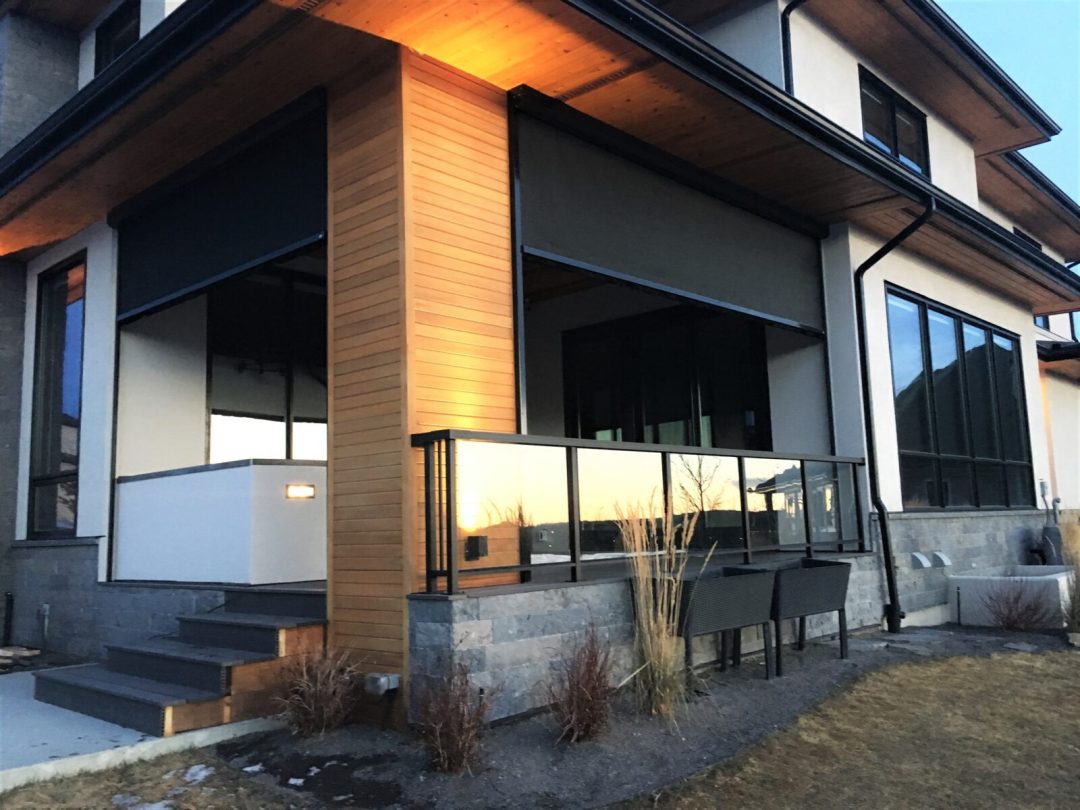

A backyard sunroom doesn't need a big yard to work — it needs the right design matched to the footprint you actually have. Best overall for small Calgary yards: a 3-season glass sunroom. Best for narrow side yards: a screen room. Best for flexible shade without walls: a louvered roof patio cover. Best for full winter use in a tight footprint: a 4-season sunroom. Best for maximizing a narrow deck: a glass wall system.
- A 3-season glass sunroom is the strongest backyard sunroom pick for most small Calgary, Cochrane and Airdrie yards in 2026.
- Screen rooms suit narrow side yards but stop working once temperatures drop below freezing.
- Louvered roof patio covers add shade control without committing to walls or a foundation.
- A 4-season sunroom is the only option on this list built for year-round Alberta winters in a compact space.
- Glass wall systems make sense mainly for homeowners who already have a deck to build onto.
Why this matters
Small yards get ruled out of sunroom projects more often than they should. The real constraint usually isn't square footage — it's picking a design that fits the lot's shape, the home's existing deck or patio, and how the space gets used across an Alberta winter.
Blueflower Sunrooms builds custom 3- and 4-season sunrooms, screen rooms, patio covers, louvered roofs, decks and glass wall systems across Calgary, Cochrane and Airdrie, and small-lot projects are a regular part of that work. The five designs below cover the realistic options for a compact backyard, ranked by what each one actually solves rather than by size alone.
Cost is a fair question to ask before you fall in love with a design. Rather than guess at a number here, the factors that move a Calgary sunroom quote up or down are broken out on the sunroom cost page, and a personalized quote accounts for your specific lot.
What makes the best backyard sunroom design for a small yard
- Footprint efficiency — how much usable living space the design adds relative to the yard it occupies
- Insulation and R-value — whether the structure holds heat through a Calgary cold snap or is strictly a warm-season space
- Natural light without glare or overheating — glazing type and orientation on the lot
- Fit with what's already there — whether the design builds onto an existing deck or patio or needs new footings
- Freeze-thaw durability — materials that handle Chinook cycles and Alberta snow load without warping or cracking
- Design flexibility — how well the layout adapts to an irregular, narrow, or oddly angled lot
Backyard sunroom designs at a glance
| Design | Best for | Standout feature | Key limitation |
|---|---|---|---|
| 3-season glass sunroom | Extending outdoor living without a full 4-season build | Maximum glazing, minimal footprint | Not built for deep winter use |
| Screen room | Narrow side yards and bug-free evenings | Open-air feel, quick to add on | No insulation, seasonal only |
| Louvered roof patio cover | Flexible sun and rain control on a compact patio | Adjustable louvers, no full walls | Not enclosed, limited winter shelter |
| 4-season sunroom | Year-round livability in a tight footprint | Full insulation and heating capability | Larger structural commitment |
| Glass wall system on a deck | Maximizing a narrow deck's view and light | Retractable or fixed glass panels | Needs an existing deck to build onto |
1. 3-season glass sunroom: best backyard sunroom for extending outdoor living
A 3-season glass sunroom uses tall glazing and a compact frame to turn a small patch of yard into usable living space from spring through fall. It doesn't carry the full insulation package of a 4-season build, which keeps the footprint and structural complexity down — a real advantage on a tight Calgary or Cochrane lot.
3-season glass sunroom pros:
- Adds a bright, open room without eating deep into the yard
- Simpler build than a fully insulated 4-season structure
- Works well tucked against an existing patio or deck edge
3-season glass sunroom cons:
- Not designed for use through a Southern Alberta winter
- Glare and heat gain need to be managed with orientation and glazing choice
Best for: homeowners who want more usable space three seasons of the year without committing to a full winter build.
Verdict: Buy — this is the strongest default backyard sunroom pick for most small yards in Calgary, Cochrane and Airdrie in 2026.
2. Screen room: best backyard sunroom option for narrow side yards
A screen room is the lightest structure on this list — mesh panels on a frame, open to airflow, closed to mosquitoes. On a narrow side yard where a full sunroom footprint won't fit, a screen room often does.
Screen room pros:
- Smallest footprint of the five designs
- Fastest to add onto an existing deck or patio
- Keeps the space open and breezy through summer evenings
Screen room cons:
- No insulation, so it shuts down as soon as the weather turns
- Offers no protection from wind, snow load, or cold
Best for: tight side yards where the priority is bug-free evening use, not year-round livability.
Verdict: Buy if summer evenings are the goal. Skip if you're hoping to use the space past October in most parts of Southern Alberta.
3. Louvered roof patio cover: best backyard sunroom alternative for flexible shade
A louvered roof patio cover isn't a fully enclosed sunroom, but it solves a problem the enclosed designs don't: adjustable sun and rain control without committing to walls. Louvers open for airflow and close for shelter, which suits a small patio that needs to do double duty.
Louvered roof pros:
- Adjusts to weather in real time instead of being fixed one way
- No full walls means a lighter visual footprint on a small lot
- Pairs well with an existing patio slab, cutting down on new construction
Louvered roof cons:
- Not enclosed, so it doesn't replace a true 4-season room
- Limited shelter once winter wind and snow set in
Best for: households in Airdrie or Calgary who want shade flexibility on a compact patio without adding walls.
Verdict: Buy for warm-season flexibility. Wait on this one if enclosed winter space is actually the goal.
"If the sunroom design eats more than a third of your usable yard, adjust the footprint before you adjust the daylight."
4. 4-season sunroom: best backyard sunroom for year-round use in a small footprint
A 4-season sunroom is the only design on this list built to hold heat through an Alberta winter. It carries insulated glazing, a proper heating strategy, and a foundation sized to the structure — more commitment than the other options, but it's the one that gets used in January as well as July.
4-season sunroom pros:
- Usable through every Calgary season, including deep winter
- Adds real square footage that functions like an extra room, not just a patio upgrade
- Custom glazing and insulation specs matched to Southern Alberta's climate
4-season sunroom cons:
- Larger structural and design commitment than a 3-season build or screen room
- Takes up more of a small lot's footprint than the lighter options above
Best for: homeowners who want a small backyard sunroom that functions year-round, not seasonally.
Verdict: Buy if year-round use outweighs footprint concerns. Hold if timing or planning needs more runway this year.
5. Glass wall system on a deck: best backyard sunroom pick for a narrow deck
A glass wall system doesn't require a new footprint at all — it builds onto a deck you already have, adding retractable or fixed glass panels that turn an open deck into a sheltered, light-filled space. On a narrow lot where there's no room for a standalone structure, this is often the only design that fits.
Glass wall system pros:
- No new foundation required if the deck is already in place
- Preserves sightlines and natural light better than a boxed-in room
- Scales to a narrow deck without expanding the yard footprint
Glass wall system cons:
- Only works if a suitable deck already exists
- Weather protection is generally lighter than a fully enclosed sunroom
Best for: homes with an existing deck and a tight side or rear yard that can't absorb a new structure.
Verdict: Buy if you already have the deck. Skip this one and look at a 3-season sunroom instead if you're starting from bare yard.
How we ranked these backyard sunroom designs
Each design was weighed against the six criteria above: footprint efficiency, insulation, natural light, fit with existing structures, freeze-thaw durability, and design flexibility. The 3-season glass sunroom scores highest on the combination that matters most for small yards — meaningful new space without a heavy structural footprint. The 4-season sunroom scores highest on durability and year-round use but asks for more commitment. Screen rooms and louvered covers trade insulation for a lighter build; the glass wall system trades independence for efficiency by leaning on a deck that's already there.
Which backyard sunroom design should you choose?
For most small yards in Calgary, Cochrane or Airdrie, the 3-season glass sunroom is the default pick — it adds real living space without demanding a large footprint or full winter build. If year-round use matters more than square footage saved, move to the 4-season sunroom. If you already have a deck and a narrow side yard, the glass wall system is the more efficient build. Screen rooms and louvered roof patio covers both work as lighter, lower-commitment additions when a full enclosed room isn't the goal in 2026.
A sunroom contractor in Calgary that measures your specific lot before recommending a design will steer you away from options that look good on paper but don't fit the space.
FAQ
What’s the best backyard sunroom design for a small yard?
A 3-season glass sunroom is generally the best fit for a small yard because it adds usable space without the larger footprint a 4-season build requires. It works well in Calgary, Cochrane and Airdrie lots where every square foot of yard counts.
Is a 3-season sunroom better than a 4-season sunroom for a small Calgary yard?
A 3-season sunroom is better when the goal is extra space without a large structural commitment, while a 4-season sunroom is better when year-round use matters most. The choice comes down to whether you want the room usable in January or just from spring through fall.
How much yard space does a backyard sunroom need in Southern Alberta?
There’s no fixed minimum — screen rooms and glass wall systems fit onto existing decks with very little added footprint, while a 4-season sunroom needs a larger, properly footed foundation. A site visit is the most reliable way to confirm what a specific lot can support.
Can a screen room handle Alberta winters?
No, a screen room has no insulation and is built strictly for warm-season use. Once temperatures drop below freezing in Calgary or Cochrane, a screen room stops being functional.
Do louvered roof patio covers work in small backyards?
Yes, louvered roof patio covers work well on compact patios because they add adjustable shade and rain control without requiring walls or a new foundation. They don’t replace an enclosed sunroom but suit yards where flexibility matters more than full enclosure.
How much does a small backyard sunroom cost in Calgary?
Cost depends on the design chosen, the size of the structure, glazing type and whether a new foundation is needed. The cost factors are broken down in detail on Blueflower Sunrooms’ sunroom cost page, and a personalized quote reflects your specific yard.
What’s the difference between a sunroom and a glass wall system?
A sunroom is typically a standalone enclosed structure, while a glass wall system adds glass panels onto an existing deck without a new foundation. Glass wall systems suit narrow decks where a full sunroom footprint won’t fit.
Can I add a sunroom to a narrow deck?
Yes, a glass wall system is usually the most efficient option for a narrow deck because it builds onto the structure you already have. A standalone 3-season or 4-season sunroom is also possible but generally needs more clearance around the deck.
One last thing
Orientation matters more than most homeowners expect on a small lot. A backyard sunroom facing south or west catches low winter sun in Calgary's shorter days, which stretches usable months even on a 3-season build — worth flagging before glazing placement gets locked in for 2026.